Corrections
| Page | Correction |
|---|---|
| xiv |
Preface, paragraph beginning “The chapters are more or less modular”. “lexical classes” should read “lexical categories”, the term the book uses throughout. |
| 81 |
§4.3.2, Test 1, example (3b). Remove the asterisk from just carefully: the phrase is possible when just has a limiting or focusing meaning. The modification test must hold the modifier's meaning constant; it doesn't show that adverbs reject every use of the listed modifiers. |
| 82 |
§4.3.2, Test 3, example (10b). Come before lunch or quickly shouldn't be marked unconditionally ungrammatical. Its acceptability depends on context. Phrases of different categories can coordinate when their functions and meanings permit it, so coordination alone doesn't establish category identity. |
| 83 |
§4.3.2, Test 4, example (12d). Remove the asterisk from the people locally, which can be acceptable in context. AdvPs have a more restricted distribution as noun modifiers than PPs, but this example doesn't establish a categorical prohibition. See also the changes globally in footnote 2. |
| 91 |
§4.3.4, “In in English and Italian”. The generalization that Italian uses su for small vehicles and in for large ones is incorrect. Italian in macchina and in treno correspond to English by car and by train. For being on a particular train, Italian can use sul treno or nel treno. The choice depends on the construction and whether a particular vehicle is specified. See Treccani's explanation of in treno, sul treno, and nel treno. |
| 94 |
§4.3.6, final sentence. “Such trees are the focus of the next chapter” should read “Such trees are the focus of Chapter 6”. |
| 95–96 |
Exercises, Part B4 and its answer. Specify that likely is being considered in the certainty use listed under adverbs in §4.2 (p. 75). The intended answer is adv, but the isolated word also has adjective uses. Rejection of the intended right modifier alone doesn't distinguish an adverb from an adjective. |
| 96 |
Answer key, Part A5. The question asks for all adverbs and prepositions in Is he in yet, or still out? The complete answer is: in prep; yet adv; still adv; out prep. |
| 96 |
Answer key, Sample Part C3. Replace here, now, upstairs with again, never, thus. The question asks for three adverbs that can't be modified by very; the printed answers are prepositions under the chapter's analysis. |
| 105 |
§5.4, paragraph before (21) and example (21a). The intended distinction is lexical versus auxiliary, so “not modal” should read “lexical rather than auxiliary”. However, Don’t be late doesn’t establish that be is lexical: negative imperatives allow do with auxiliary be. Use Why don’t you be more tolerant? to illustrate lexical be, and retain the imperative as an exception to the usual diagnostic. See Huddleston & Pullum (2002), The Cambridge Grammar of the English Language, §2.3, p. 105, and §2.5.7, pp. 113–114. |
| 107 |
§5.5, introduction to (28). Replace the claim of “seven distinct tenses” with a description of the eight listed tense–aspect examples. The list includes habitual wa-wat ‘usually go’, and footnote 5 already notes that the forms combine tense and aspect. The number of examples isn’t a count of distinct tenses. |
| 108 |
Exercise, first paragraph. Replace the claim that French speakers don’t care about the distinction between I do it and I’m doing it with a statement about conventional marking: French often uses je le fais where English distinguishes those forms; Je suis en train de le faire makes the ongoing interpretation explicit. The grammatical contrast doesn’t establish what speakers care about. |
| 108 |
Exercise, second paragraph. Identify the variety as Cuzco Quechua and remove the claim that every assertion must mark its information source. Assertions without an evidential are possible, so an unmarked assertion isn’t necessarily incomplete or misleading. See Martina T. Faller (2002), Semantics and pragmatics of evidentials in Cuzco Quechua, pp. 23–24 and 145. |
| 109 |
§5.6, example (29b). Replace I would walk to school yesterday with I would walk to school, introduced as a past routine. The original is an awkward standalone illustration of habitual would. The form would remains past tense in the chapter’s analysis. |
| 111–112 |
§5.7.1, discussion of (36). Remove the restriction of I’m living in Mississauga to someone such as an international student. Other speakers can use the progressive to present their residence as temporary. The choice concerns how the speaker portrays the situation. |
| 112–113 |
§5.7.1.1, examples (37)–(38). Qualify the grammaticality judgments by variety and intended interpretation. Footnote 7 already records the use of I’m knowing that feeling in South Asian English. The progressive examples in (38) are compared with ordinary general statements; specially supplied temporary readings can change acceptability. |
| 113 |
§5.7.1.1–2, discussion of (39) and repeated events. Present the relevance of time-limitedness as the chapter’s account, without requiring an impending end to matter in every use. We’re having dinner, He’s being grumpy, and It’s tasting sweeter can describe an activity, temporary behaviour, and a developing or contextually limited experience. The gym-membership and commitment scenarios are illustrations, rather than necessary conditions for the progressive. |
| 114 |
§5.7.1.2, restaurant example. I’m eating at that new restaurant can describe either a meal in progress or a current pattern of visits. Being inside or outside the restaurant can provide a contextual clue but doesn’t determine the interpretation. |
| 114 |
§5.7.1.3, discussion of (40). Remove the categorical requirement that the dinner must already have been arranged and the Smiths invited. The progressive can present an event as part of a current plan; it can also announce a plan. The amount of prior arrangement required depends on context. |
| 118 |
“No progressive perfect” box. Present the explanation in terms of the relevance of an endpoint as this chapter’s analysis. Keep that explanation distinct from the grammatical observation: I’ve been trying is possible, while I’m having tried is ungrammatical. |
| 119 |
§5.8, introduction to (43). It’ll work and It should work compare different modal verbs, rather than the present and past forms of one verb. Table 5.5 pairs should with shall. Keep (43) as a comparison of likelihood and use the will/would pair in (44) to illustrate tense-related remoteness. |
| 119–120 |
§5.8, example (45) and its introduction. Treat the “intimate” and “public” labels as contextual illustrations, rather than fixed divisions between interlocutors. Would can make a request more tentative or polite; the effect depends on context and intonation. |
| 121 |
§5.8.1, examples (49)–(50). I am reading a book doesn’t entail reaching the end: replace “until the end” with “progressive”. The book was read describes a passive construction and can report an event: replace “resultant/state” with “passive”. These meanings belong to constructions in context, rather than following from participle forms alone. In noun modification, participle-shaped words such as sleeping and broken can also be adjectives; their shape and meaning don’t settle the category. |
| 121 |
Exercise, Part 1. In (a), extend the bold target from have been to have been trying, so the target includes the full perfect-progressive construction. In (b), retain have completed and allow “no tense” as an answer: this infinitival target is non-tensed, and should is outside it. The instructions should ask for each target’s tense, if any, and aspect. |
| 122 |
Exercise, Part 3(c). Replace The broken vase lay on the floor with The book was read, already used in (49c). The exercise asks for non-tensed verb forms, but broken in the original allows an adjective analysis. The replacement supplies a clear verbal past participle. |
| 136 |
§6.5.2, A top-down example. The last two trees show I helped you, but the text is building a tree for I had my breakfast. The corrected trees: 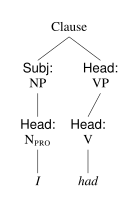
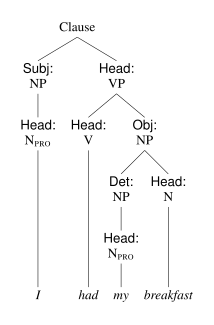
Reported by Zulfiyya Ahmadova · PaperHive page 158 |
| 136 |
§6.5.2, last paragraph before the final tree: “with its Det:DP my” ⇒ “with its Det:NP my”. My is a pronoun, so it heads an NP (see §3.5, Noun phrases as determiners). |
| 156 |
§7.3.1, list of tongue parts. The entry for the front of the tongue calls ship a palatal sound, but the place-of-articulation list in §7.4.1 (p. 157) classes /ʃ/ as post-alveolar and gives /j/ as the only palatal consonant. Replace “palatal sounds like /ʃ/” with “sounds made toward the hard palate, like /ʃ/”. |
| 161 |
§7.5, paragraph before Figure 7.4. Replace “no red wavelengths in the image” with “no red pixels in the image”. The claim concerns the colour of the pixels, and the figure caption already says “containing no red pixels”. |
| 162 |
§7.5, final paragraph. Replace “phones are the smallest language sounds that make a difference in human language” with a description of phones as the speech sounds found across human language, whether or not they make a difference in a particular language. As printed, the definition is close to that of a phoneme. The chapter’s own [tʰ] and [t] are distinct phones of English that make no difference to meaning. |
| 165 |
§7.6, paragraph on mad and mat. Replace “This is because” with “One explanation is that”. The chapter gives no source for the mechanism, so it should be offered as an explanation rather than as the settled cause of the longer vowel before voiced consonants. |
| 183 |
§8.3.2, first paragraph. Remove “Proficient adult speakers of English typically know 20,000–35,000 word families, with university-educated speakers often knowing more.” The estimates the chapter relies on are those in Figure 8.2 (p. 184): about 11,100 word families for 20-year-old first-language speakers, 13,400 for 60-year-olds, and 16,700 for the highest first-language bar. The 20,000–35,000 range doesn’t match them. |
| 183, 184, 477 |
Table note on p. 183, §8.3.2 on p. 184 (“Nation 2013: 29”) and the references on p. 477. “Nation (2013)” should read “Nation (2022)”. The DOI printed in the references, 10.1017/9781009093873, is the third edition of Learning Vocabulary in Another Language, published in 2022. The page reference on p. 184 was not rechecked against that edition. See the Cambridge University Press record (Crossref: edition 3, published 2 June 2022). |
| 184 |
§8.3.2, paragraph introducing Figure 8.3. Replace “approximately 80%” with “about 78%” (read from the plot, which has no data labels) and replace “add only about 6% more coverage” with “bring coverage to about 86%”. The 86% figure for 2,000 families, given at the end of the section, matches the plot. |
| 185–186 |
§8.3.3, last sentence (pp. 185–186). Remove “approximately 93% coverage of academic texts”; the chapter gives no source for it, and the figures in Advanced exercise 4 (p. 193), about 80% for the 2,000 most frequent families and about 10% for the Academic Word List, add to about 90%. Say instead that adding the Academic Word List raises coverage of academic texts substantially. Coxhead’s own figures are 10.0% for the list and 86.1% for the list plus the first two thousand General Service List families, in her Academic Corpus. See Averil Coxhead (2000), A new academic word list, TESOL Quarterly 34(2), Table 4 (p. 223). |
| 187 |
§8.4.2, first paragraph. The judgments “In English, we make a decision but take a break (not *take a decision or *make a break in most varieties)” hold for North American English. British English allows take a decision. |
| 189 |
§8.5.1, example (3c). Only She gave him a book is ditransitive, with him and a book as its two objects (the definition on p. 124). In She gave a book to him, to him is a PP complement, not an object, so the clause isn’t ditransitive. Read (3c) as Give allows a ditransitive clause (She gave him a book) and a version with a PP complement (She gave a book to him). See Huddleston & Pullum (2002), The Cambridge Grammar of the English Language, §4.3, p. 248. |
| 190 |
§8.6.1, first paragraph. Replace “research consistently shows it actually impedes learning” with “research suggests it can impede learning”. Finkbeiner & Nicol (2003) found interference in laboratory learning of 32 new labels in four categories, and Waring (1997) describes his replication as tentative, concluding that semantic clusters “can interfere with learning”. See Finkbeiner & Nicol (2003), Applied Psycholinguistics 24(3), p. 379; Waring (1997), System 25(2), abstract (p. 261). |
| 193 |
Advanced exercise 3, sentence (b). Replace *Three hours elapsed the meeting with *The committee elapsed before the rescue team arrived, example (4b) in §8.5.2. Both printed sentences put an object on an intransitive verb, so they illustrate the same kind of knowledge, complementation. The replacement violates a selectional restriction instead, which gives the question two different kinds of knowledge to compare. |
| 193 |
Advanced exercise 4. Replace “only about 2% of fiction” with “only about 1.4% of fiction”. Coxhead reports the Academic Word List at 1.4% of the tokens in her fiction collection, which consists of public-domain texts written more than fifty years ago. The 10% figure for academic texts matches her results. See Averil Coxhead (2000), A new academic word list, TESOL Quarterly 34(2), abstract (p. 213) and pp. 224–225. |
| 229 |
§10.5.3, final paragraph, on (12). The text says that only the interrogative PP about what starts with a non-interrogative word. In (12b), Until when are you free?, the interrogative phrase is the PP until when, which starts with the preposition until. Two examples in (12) have this property, not one: read “all the other examples” as excluding (12b) as well as (12g), and “Only the interrogative PPs until when and about what start with a non-interrogative word.” |
| 231 |
§10.5.3, examples (13)–(15). The asterisks on What did happen next?, Who did tell you that? and Which solution does work best? apply to unstressed did and does. With stress on the auxiliary, these are acceptable emphatic questions. The paragraph after (15) already makes this qualification for Who did come to the party?, which it marks as an error “when asking for new information, not emphasis”. |
| 236–237 |
§10.7.1, Figures 10.7 and 10.8b. The trees label the complements be right, like pizza and play Clause, which is CGEL’s label for them. Chapter 5 (p. 104, note a) uses “VP” where CGEL says “clause”, and the audio companion follows that convention, so it describes these complements as VPs. |
| 241 |
§11.2.1, Stage two, example (2). In the gloss line, schall should read shall: “no(t) shall no man with word nor with deed no evil do”. |
| 242 |
§11.2.1, end of Stage three. “The early grammarians of Late Modern English (1700–Present) seem to have thought them obsolete by 1762 (Gilman 1989: 365)” goes beyond what Gilman says. Gilman credits Lowth (1762) with the classic statement that two negatives destroy one another, and says that Lowth “thought the old practice was obsolete”: the old emphatic multiple negation was “passing out of literature in Lowth’s time” and was restricted to familiar use, “conversation and letters”. Read “Lowth (1762) seems to have thought the old multiple negation obsolete, though it survived in conversation and letters”. See E. Ward Gilman (ed.) (1989), Webster’s Dictionary of English Usage, Merriam-Webster, p. 365. |
| 244 |
§11.2.1, Stages six and seven. In “the difference in their vowels (/kən/ vs /kæn/)”, the order can be read as giving can’t the reduced vowel. It is positive can that has the reduced (weak) form /kən/; can’t keeps a full vowel (/kænt/ in American English). See Huddleston & Pullum (2002), The Cambridge Grammar of the English Language, Ch. 18, §5.5, p. 1611, and §6.1, p. 1613. |
| 246 |
§11.2, Summary, last paragraph. “Recall how pease became peas (Section 1.2.2)?” points back to the Countability section (p. 13), which doesn’t mention pease or peas; the example doesn’t appear anywhere else in the book. Read “Think of how pease became peas” and drop the cross-reference. |
| 248 |
§11.3.1, last paragraph. The claim that “most of the negative modal auxiliary verbs are like can’t” isn’t supported. Shouldn’t patterns with mustn’t: in You shouldn’t do it, the advice is not to do it, so the modal sits outside the negation. Others, like can’t, have their modal meaning within the scope of negation. The pattern varies from modal to modal. See Huddleston & Pullum (2002), The Cambridge Grammar of the English Language, Ch. 3, §9.10, p. 204: “There is a general tendency for strong or medium modals to take internal negation, and for weak modals to take external negation”, with He mustn’t/shouldn’t go with them as internal and He can’t go with them as external. |
| 249 |
§11.4, paragraph beginning “The seeming relationship”. “Both of the (i) examples in (4)” should read “both of the (ii) examples in (4)”. The (ii) examples, You can’t do it and You mustn’t do it, are the negated ones; the (i) examples are positive. |
| 249 |
§11.4, paragraph introducing Figure 11.2. “Pragmatic negation … is a semantic phenomenon” should read “is a matter of meaning rather than syntax”: it isn’t a syntactic type of negation, so it doesn’t belong in the taxonomy. |
| 250 |
§11.4.1, paragraph after (6). Remove the claim that the negative markers in (6) “have scope only over the NP in which they function as a determiner” and “don’t have scope over the verb, let alone the whole clause”. Scope is a semantic matter (as §11.4 says), whereas (6) illustrates a syntactic one: no and neither are determinatives functioning as determiner inside the NP, not attached to the verb, and the clauses are still syntactically negative. See Huddleston & Pullum (2002), The Cambridge Grammar of the English Language, Ch. 9, §3.2.1, pp. 812–813. |
| 250 |
§11.4.1 and §11.4.2. The text twice promises to explain in Section 11.5 why the non-verbal clauses in (6) are negative (“I’ll explain in Section 11.5”) and why the sub-clausal clauses in (7) are positive (“Again, I’ll explain this claim in Section 11.5”). Section 11.5 gives tests (at all, ever, yet) for checking whether a clause is positive or negative and applies them to verbal and non-verbal negation, but it doesn’t explain why the non-verbal clauses count as negative, and it doesn’t apply the tests to the sub-clausal examples in (7). Read the promises as pointing to the tests. |
| 253 |
§11.5.1, paragraph before (15). “At all, even, and yet are by no means the only non-affirmative items” should read “At all, ever, and yet”. Those are the three items tested in (10)–(14); even isn’t tested there. |
| 256 |
§11.5.2, “Pattern recognition: polarity items” box, third bullet. The example Before you know it, there won’t be some left doesn’t match the one in the text above (p. 255), Before you know it, there won’t be any left, where the positive polarity item is before you know it, appearing in a negative clause, and any is the non-affirmative item. Use the text’s example. |
| 259 |
§11.7.2, first paragraph. “Approximate negators like few, a few, or hardly any”: remove a few. It isn’t an approximate negator; it is a positive paucal determinative. See Huddleston & Pullum (2002), The Cambridge Grammar of the English Language, Ch. 9, §3.3, p. 815 (the approximate negators are few, little, rarely, seldom, barely, hardly, scarcely), and Ch. 5, §7.10, p. 391 (a few among the positive paucal determinatives). |
| 262 |
§11.8, Summary. “Learner errors in negation almost always recapitulate historical patterns or follow productive analogies” should read often, as in the language-change summary (p. 246: “the mistakes often recapitulate plausible past or future forms of the language”). The chapter doesn’t support the stronger claim. |
| 348 |
§16.1.1, the sentence citing Jeon & Kaya (2006) and Ren et al. (2023). Replace “compared to mere exposure to the language” with “compared to no instruction”. Jeon & Kaya describe their finding as a difference “over no instruction” (p. 165), and Ren et al. include studies that compared experimental and control groups without specifying what the control groups received (p. 1015). See Jeon & Kaya (2006), “Effects of L2 instruction on interlanguage pragmatic development: A meta-analysis”, in Norris & Ortega (eds.), Synthesizing Research on Language Learning and Teaching, pp. 165–211; Ren, Li & Lü (2023), “A meta-analysis of the effectiveness of second language pragmatics instruction”, Applied Linguistics 44(6): 1010–1029. |
| 350 |
§16.2, paragraph after (4). Replace “These principles of cooperation operate in all languages” with “Something like these principles of cooperation seems to operate in many languages”. The chapter gives no source for the universal claim, and Keenan’s study of Malagasy reports that speakers there don’t treat being informative as a default expectation. See Elinor Ochs Keenan (1976), The universality of conversational postulates, Language in Society 5, pp. 70 and 75–76. |
| 352 |
§16.2, “Abduction as the engine of implicature”. Replace “is universal” with “seems to be shared across languages”. The chapter offers no source for the universal claim. |
| 352 |
§16.3, text around (6). The lead-in “requests/directions” should read “requests, or directives”, matching the labels in (6). The sentence after (6) should say that the three examples do the same task “through different clause types”, not “through different types of speech acts”. They are imperative, interrogative, and declarative clauses used with one illocutionary force, that of a directive. See Huddleston & Pullum (2002), The Cambridge Grammar of the English Language, Ch. 10, §3.1, pp. 858–859. |
| 354 |
§16.3, discussion of (8). Replace “similar locutionary meaning (expressing the listener’s knowledge of the meeting time)” with the contrast between the two responses: I know presents the information as already known, and I see takes it in as new. The responses differ in what they say as well as in what they do. The rest of the paragraph stands. |
| 355 |
§16.4.1, discussion of refusals. “Refusals threaten both faces” should read “Refusals threaten face on both sides”. The two aspects of face introduced just before are positive and negative, but the explanation lists two threats to positive face, the asker’s and the refuser’s. |
| 356 |
§16.4.3, paragraph after the three factors and introduction to (11). Present both statements as rough tendencies: “As a rough tendency, as power difference and social distance increase...” and “As a rough guide, the relationship between these factors can be seen in...”. The chapter gives no evidence for the modal pairings in (11). |
| 358 |
“Addressing the teacher”, the Teacher bullet. Replace “the second is rarely used at all” with “the second is rarely used in English”. The sentence follows a description of what learners do, so “at all” left unclear who rarely uses teacher with a name. |
| 360 |
§16.6, paragraph beginning “Beyond the type of instruction”. Replace “both meta-analyses suggest” with “a recent meta-analysis suggests”. Ren et al. (2023) found significantly larger effects for longer treatments (pp. 1020–1021). Jeon & Kaya (2006) found larger mean effects for instruction of more than five hours, but urge caution in interpreting the difference (pp. 197–198). |
| 360 |
§16.6, paragraph beginning “Learner characteristics”. Remove “intermediate-level learners and”. Ren et al. (2023) found larger effects in foreign-language than in second-language settings (p. 1019). For proficiency, only the difference between intermediate and novice learners was significant, and only one study involved advanced learners (p. 1021). Jeon & Kaya (2006) did not test learner proficiency or setting as moderators. |
| 367 |
§17.2.1, first paragraph. Replace “As Schegloff demonstrates in his work on conversation analysis, they are a fundamental part of how interaction is organized” with a statement that conversation analysts treat such adjustments as part of how interaction is organized. The cited Schegloff (1982) mentions speeding up the pace of talk near a possible turn completion, but as one device for extending a turn; it doesn’t argue that micro-timing adjustments are fundamental to how interaction is organized. The point that talk is organized on several nested timescales is supported by Fauviaux et al. (2024). See Schegloff (1982), “Discourse as an interactional achievement: some uses of ‘uh huh’ and other things that come between sentences”, p. 76; Fauviaux et al. (2024), PLOS ONE 19(9): e0309831. |
| 368–369 |
§17.2.1.1, discussion of (1). The printed excerpt doesn’t state the speakers’ relationship, so “the casual familial discussion” should read “the casual discussion between people who know each other well”. It also doesn’t name Steph’s pregnancy: the talk implies it (She’s getting fat, Eighteen week appointment), and only the textbook version in (2) says She’s pregnant. “Steph’s pregnancy” should read “Steph, whose pregnancy the talk implies”. |
| 369 |
§17.2.1.1, last paragraph before the exercise. Replace “Wilson & Wilson (2005) found that” with a description of their proposal. Their paper is a theoretical model: they propose that oscillators in speakers’ and listeners’ brains become mutually entrained on the speaker’s rate of syllable production, which accounts for the cyclic timing of silences between turns. The paper doesn’t discuss scripted materials, so the claim that these rhythms are largely absent from scripted materials needs its own source or should be presented as the chapter’s own claim. See Wilson & Wilson (2005), “An oscillator model of the timing of turn-taking”, Psychonomic Bulletin & Review 12(6): 957–968, abstract (p. 957). |
| 370 |
§17.2.2, first paragraph. Qualify “just one cultural model of how talk should be organized”. Stivers et al. (2009) compared the timing of responses to polar (yes-no) questions in informal conversation in ten languages from five continents. Speakers of every language avoided overlapping talk and kept silence between turns short, and the languages’ mean response times fell within about a quarter of a second of the cross-language mean. Tempo differs across languages, but the avoidance of overlap and of long gaps was found in all ten. See Stivers et al. (2009), “Universals and cultural variation in turn-taking in conversation”, PNAS 106(26): 10587–10592, abstract (p. 10587) and Results (p. 10588). |
| 371 |
§17.2.2, discussion of (3). Two corrections. (i) The transcription marks no overlap: Gross’s What was your comeback? comes in while Summer’s sentence is unfinished (much…) and Summer completes it afterwards (…to my chagrin), so “overlap with Summer’s speech” should read “come in before Summer has finished her sentence”, and “these overlaps” should read “moves like this”. (ii) You know? isn’t a tag question (see p. 65 for the book’s own examples, isn’t it? and isn’t there?); call it an expression used to check understanding. The index entry “tag question, 65, 371” should then lose 371. |
| 372 |
§17.2.3, discussion of (4). Only one of the three completions starts with then: replace “often starting with words like then” with a statement that in (4b) the completion starts with then. The completions in (4a) and (4c) start with ih don’t and they’re. |
| 375 |
§17.3, commentary on (9). “incomplete Par” should read “incomplete Pa”, matching the student’s turn in (9); Par… is the teacher’s turn. |
| 384 |
§17.7.1, paragraph after (20). The sentence that people “frequently underestimate how much their partner liked them and enjoyed the interaction” reports the liking gap described by Boothby et al. (2018), and should cite that paper. The preceding claim about pessimism is Welker et al.’s (2023). See Boothby, Cooney, Sandstrom & Clark (2018), “The liking gap in conversations: Do people like us more than we think?”, Psychological Science 29(11): 1742–1756, abstract (p. 1742). |